
Profitable Services: 4 steps to doing the impossible in B2B SaaS
A guide on transforming Services from a loss leader into a strategic differentiator, cash generator, and retention driver for your SaaS business.


I recently caught up with a friend and PE investor focused on lower-middle market software companies. We meandered to the topic of driving profitable services within SaaS operations. This was an issue I was familiar with having been a part of standalone services organizations and led embedded services organizations within software companies. Traditionally, services has been viewed as a loss leader to drive growth of software annual recurring revenue. That was certainly my early experience at a VC-backed tech company. We had a high-powered consulting and implementation team, one I’d bet my bottom dollar on against any other team in the industry at that time - but, we rarely charged for the value and when we did, it was discounted with the fear it would jeopardize our odds of winning deals and keeping customers happy. However, key disruptions in the B2B SaaS industry are forcing companies to rethink their traditional growth strategies, and deliver profitability to their shareholders:
SaaS growth rates are tapering - according to SaaS Capital, B2B SaaS growth rates are down anywhere from 5-15% compared to growth rates in 2022.
Heightened focus on profitable growth - a survey by Alix Partners in 2023 for 140 technology executives found that 74% plan to prioritize profitability over or equal to growth over the next 24 months.
Services as a value add - a study by KeyBanc Capital showed companies with 25-50% services attach rate achieved 93% GRR vs. 87% for those that offered services for free.
While Services isn’t traditionally a core competency for a B2B SaaS company, it can be a secret weapon in the midst of these changing market dynamics - driving differentiation with customers, cash to accelerate investments, a buoy to buffer the market uncertainty, and stickiness to bolster retention and expansion. The good news is it’s doable! In one of the Customer Success & Professional Services organizations I led within a software company, we turned a loss leader into a profit center moving gross margin from -30% to +30%, drove 50% of services as recurring revenue, and enabled 94% retention for customers with higher services engagement sub-90% for those without.
Types of Services within SaaS
To level set on what we’re referring to, types of services within SaaS are:
Implementation - onboarding a customer to a new product for the first time including design, configuration, integration, testing, training.
Support - inbound tickets, typically bugs or defects, how-to-questions, basic training, reporting assistance, configuration or integration triage
Customer Success - regular engagement, promotion of value and advocacy of new capabilities and expansion opportunities. Depending on the GTM motion, Customer Success can also be in charge of renewals and have an upsell / expansion quota.
Professional / Technical Services - post go-live enhancements, integrations, assessments.
Managed Services - recurring administration, configuration, analytics or other types of “do-it-for-me” services.
Implementation, Support, and Customer Success are 3 most common since they are basic necessities to onboard new customers to the product and to support them throughout their customer lifetime. Professional Services and Managed Services though less common can often drive high value differentiation, stickiness of your solution (e.g. integrations or staff augmentation), and expansion by identifying upsell/cross-sell opportunities during these engagements. Note that all businesses aren’t made equal. For example, companies targeting SMB customers may not have a fit or justification on spend for high value professional services. Other product-led growth companies may have less initial implementation services.
“But Enterprise Value is based on ARR…”
If the enterprise value of the business is based on software ARR (not services), why bother? Fair question. Let’s take a look at some examples where driving profitable services is accretive and an accelerant to your EV goals.
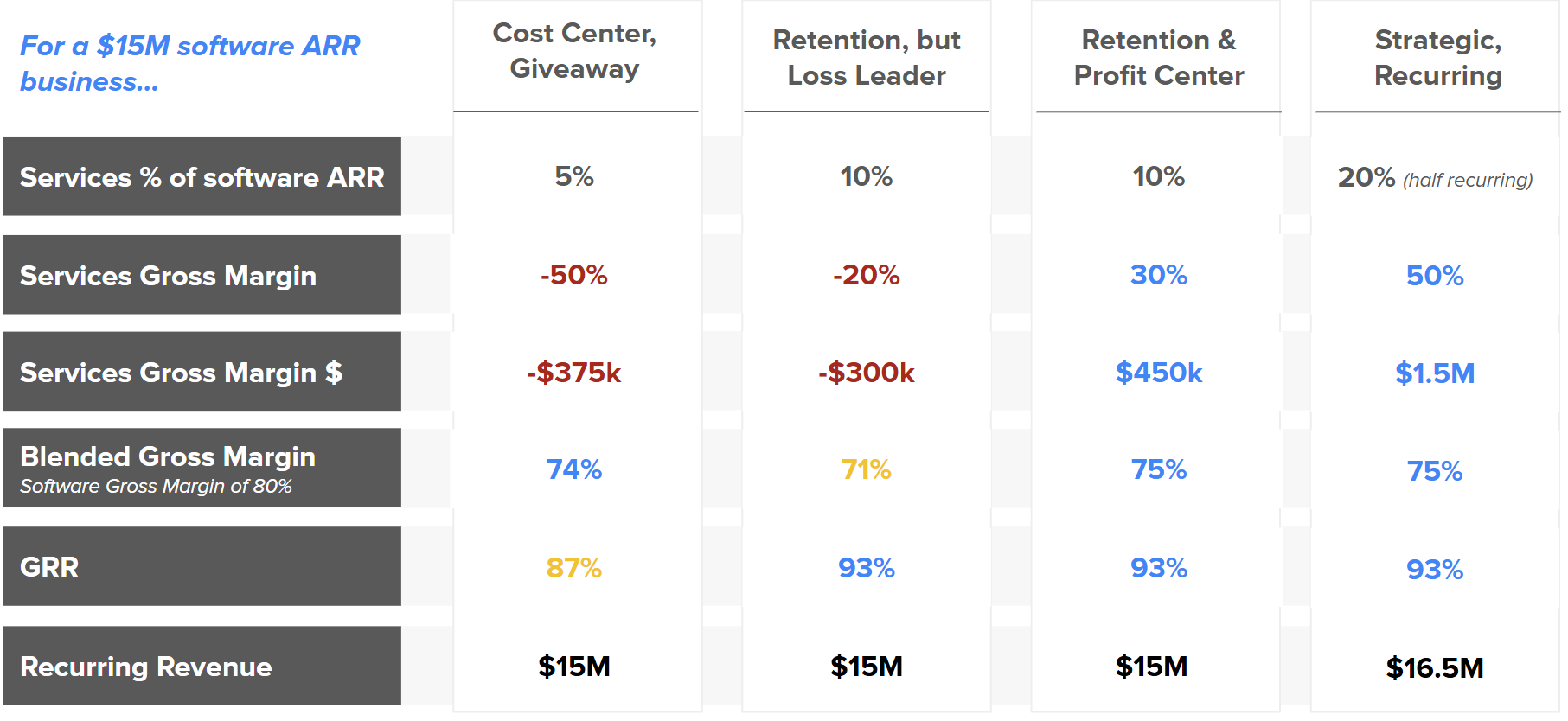
Going from left to right…
Cost Center, Giveaway - services in this company is seen as a cost of doing business. Services are given away or heavily discounted in order to win business. Services profitability is very negative and due to the lack of operational discipline and “skin in the game” from customers, it’s typical to see implementations not go-live yielding in lower retention, or support going beyond the extra-mile servicing a customer request only to find it being a detriment to usability long term.
Retention Driver, but Loss Leader - this company charges more, but is ok with treating services as a loss leader. There lacks operational focus and rigor to manage implementation, support, customer success man-hours spent. While there may be benefits in more “skin in the game” from customers, blended gross margin (software & services) is actually worse than the first company due to the gross margin loss on services.
Retention Driver & Profit Center - this company is looking to drive services as a profit center. The pricing isn’t too dissimilar from the prior company, but there’s more operational discipline to drive repeatable use cases leading to reliable customer outcomes as well as internal efficiencies and cost leverage. They get $750k more cash on the balance sheet to invest in the business and better blended gross margin.
Strategic, Recurring - this last company has identified a market-fit for ongoing services or support that allows them to charge on a recurring basis. Because the nature of the work is recurring and differentiated, it allows them to increase price and leverage off-shore resources. This results in $1.5M in gross margin to re-invest in the business or bank in EBITDA, and an extra $1.5M in recurring revenue. In addition, services assessments are leveraged to recommend business improvements for customers (including potential upsell / expansion opportunities).
So, while the initial reaction may be that services is dilutive to your core objectives, imagine what your Enterprise Value could be with (a) higher GRR, (b) more cash to accelerate investments, (C) levers to accelerate ARR expansion…all while maintaining the same company gross margin profile.
4 Steps to driving profitable Services
So, how do we do it? On the surface, the difference in how to run a traditional software business vs. a services business can be stark. I won’t minimize this because they certainly are different, but there are 4 common steps or building blocks that lead to sustainable, profitable growth..
In pure-play software, this means:
Value & retention - what is your ICP and what value is your product(s) creating for customers? Are you able to drive predictable retention and usage of your solution?
Operational repeatability - how similar or different is the solution and use cases across your customer base? If you hired a new employee, how long would it take to train them to sell and support your customers? Are your CAC and cost-to-serve going down for each incremental customer?
Revenue predictability - how predictable is the revenue month over month, quarter over quarter? This is a bit of a “gimme” with traditional SaaS being on an annual or monthly subscription but forecast variability can exist with new deal volume, churn, or variable pricing models.
Profitable growth - where can you maximize pricing and GTM efficiency? Where can you drive cost leverage via infrastructure, automation, or cost-effective contractors and off-shore resources?
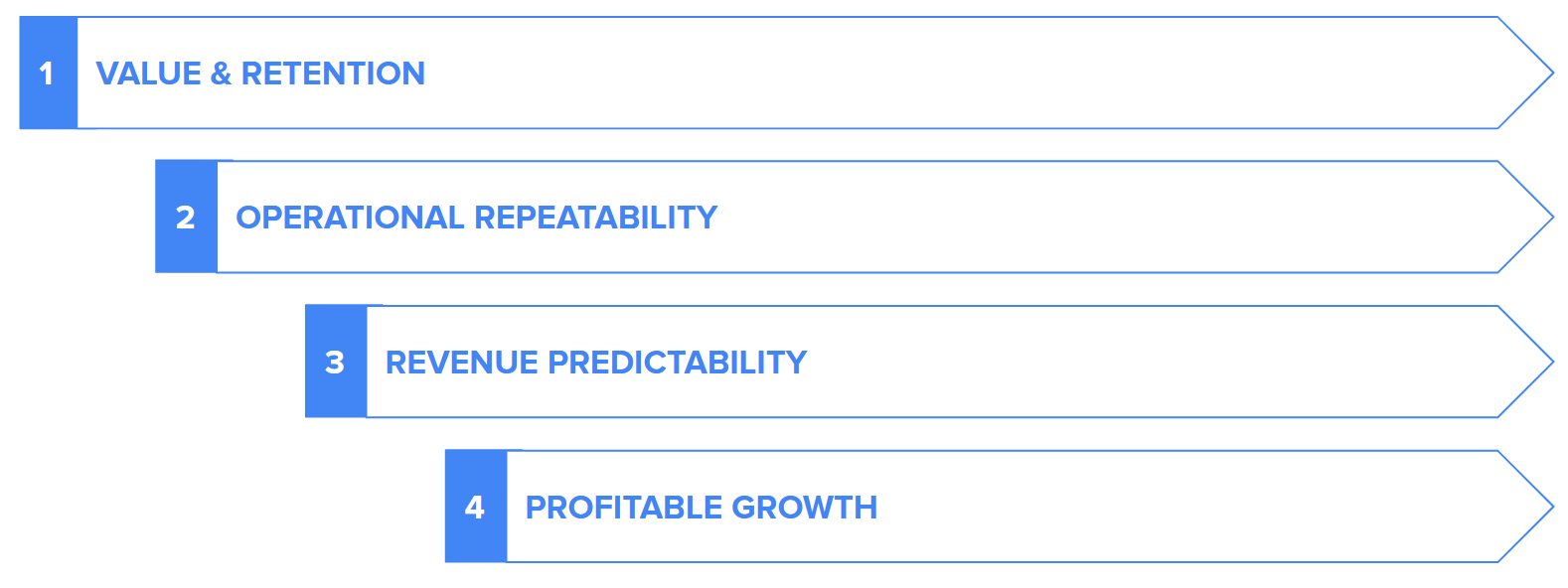
If we apply this same framework to services, much of the same is true but there are a few key differences. I’ll take these one by one.
Value & Retention
Everything starts here because if there’s no perceived value for customers, it’s very hard to drive repeatability, impossible to command the pricing needed to scale, and can be a detriment to customer retention. Start by finding the win-win - the value of the combined solution of software and services should be more than than the sum of its' parts. Approach this just like you would in software product management.
Identify the pain and your ICP - for example, there may be enablement gap for customers to use your product effectively or a thought leadership gap in your market, particularly with mid-market customers without internal resources and expertise.
Develop a hypotheses, experiment, validate - for the enablement gap, could there be a series of specialized training that is accessed through support and that customers would pay a subscription for? For the thought leadership gap, could you invest in consultative implementations and services that provide expert advisement that command higher pricing and can accelerate identification of expansion opportunities?
» If successful, services are frequently adopted and at a moderate revenue attach rate. GRR & product usage for customers adopting services is higher than those that don’t.
Operational Repeatability
Like in manufacturing, more volume of the same thing drives productivity and throughput. Switching costs between products creates down time, reduces capacity, and increase quality risk . I’m grossly oversimplifying the world of B2B SaaS given nuances of customers’ businesses compared to manufacturing millions of widgets off a production line but the principle holds - repeatability builds efficiency.
Custom code and tech debt is common within software but there is some innate friction in the software development lifecycle (SDLC) to scope, make and deploy changes. Services in contrast is delivered via humans and customer-centric humans can be creative. If a customer has an urgent support request, it’s easy to step in and spend hours solving the problem for them rather enabling customer to learn. If a customer has a one-off project request, it doesn’t take much to come up with a bespoke scope of work to bring in cash but risks repeatability. From my experience, there’s a few key tenets in driving repeatability.
Disciplined product management - clear software product feature and functionality definition, standard use cases, roadmap management, feature request processes, and documentation. Services is an amplifier of value of the product, so if product management is loose, then services repeatability doesn’t stand a chance resulting in time spent researching custom deployment documentation for a specific customer, misinterpretation / mis-implementation of standard product, etc.
Standard service offerings - define the objectives, activities, packaging & pricing for your services. This isn’t OSFA across SaaS companies but you can use the types of services listed earlier as a starting point. Each offering, package, or add-on needs to have discrete value and a set of activities that is mutually exclusive of each other. There isn’t hard fencing off features like in software so clearly lay out what’s included and what’s not, internally and externally.
Enablement - frequently taken for granted. Everyone knows what the product does and what outcomes it drives for customers right? Wrong. If skipped, the result is that you’ll have customer success & support “order taking” from customers rather than asking the right questions to help customers gain value out of your solutions…or implementation consultants unintentionally increasing scope (cost and time) for little gain in value. And without a central enablement motion, you may find teams with 3 different solutions for the same use case making it less efficient, more costly to resource and service customers - a nightmare for driving repeatability.
A litmus test is the ability to quickly ramp and staff resources across various assignments. If you’re in a position where the business is over-reliant on special knowledge or skills of very few individuals, that can be one of 2 things. (1) there’s a skill development need or (2) this can be a tell-tell to revisit your product and services management practices - too many use cases, lack of clarity on ICP or product definition, or bespoke product or services with outcomes that can’t be reliably and repeatably produced.
» If successful, time-to-value (implement, support resolution, expansion, etc.) should decrease over time.
Revenue Predictability
Solving for the revenue model. In practice, this isn’t a sequential step after first achieving repeatability, but rather iterated through in parallel. The importance is that there’s more enterprise value placed on companies that can generate a predictable revenue model that investors can understand, mitigate their downside risk, and scale.
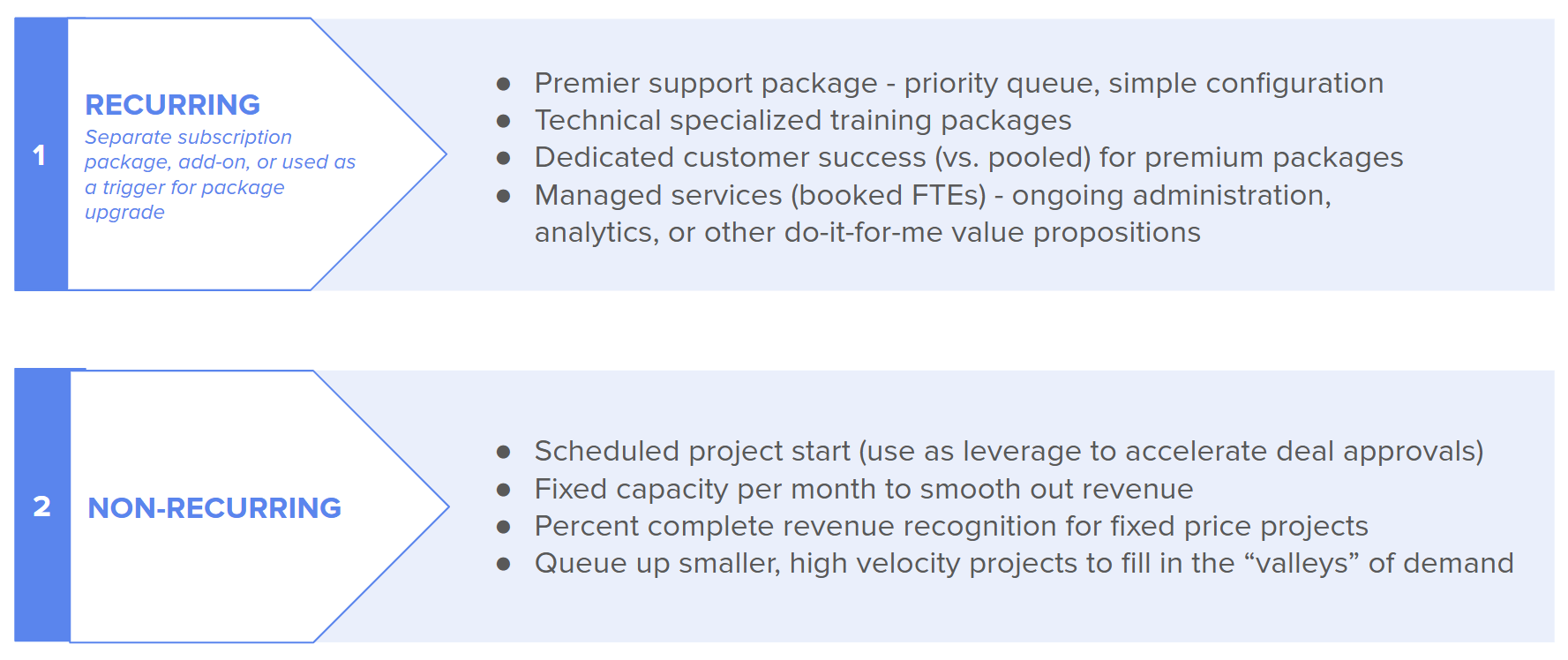
When a customer signs a software subscription, that revenue is very predictable less assumptions around customer-wide churn. In contrast, many services are non-recurring and therefore can be lumpier.
Recurring activities are things like ongoing Support tickets, Customer Success driven engagement and business reviews, monthly analytics, or managed service administration.
Examples of non-recurring activities might be an initial implementation of a new customer or an add-on integration 18 months after a customer is onboarding.
Here are some “plays” to experiment with to drive revenue predictability.
Hand in hand with the revenue model is operational predictability. You can find a helpful deep dive on optimizing PSO operations concepts here, but a quick overview below. While this is most applicable to billable services engagements, the essence of balancing time, resources, engagements, and revenue are applicable even for support and arguably parts of customer success.
Tracking Time & Expenses - time is the atomic unit of professional services and revenue generation. Know where your team members’ time is going to be able to start measuring utilization and easily recognize revenue on projects.
Project Management - effective management of scope, timeline, budget, and invoicing. Good management leads to predictable timelines and profitability. Proficient project managers can know when to press and let off the gas based on internal supply/demand compared to customer deadlines.
Resource Planning - balance the right resource (skillsets), right project, at the right time. Particularly with ebbs in flows in projects, the ability to do this effectively can level load demand across the team driving more sustainable operations.
Revenue Forecasting - match project accounting and revenue recognition with the general ledger. Much more complicated than you’d think once you factor in various services types and contract types (T&M, fixed fee, retainers, subscription).
» If successful, revenue actuals vs. forecast variance should decrease over time, on-time delivery and team utilization should go up.
Profitable Growth
Then the fun part. If the foundation is set, this should be more seamless. In the times I’ve seen friction in driving or sustaining profitability, it’s typically linked back to one of the 3 prior steps: a subpar value proposition or lack of quality, lack of repeatability in products and services, and low revenue predictability.
Below are a few “plays” to run in driving profitable growth and some common points of friction to watch for or pressure test in your organization should you sense and objections on implementing these from your team.
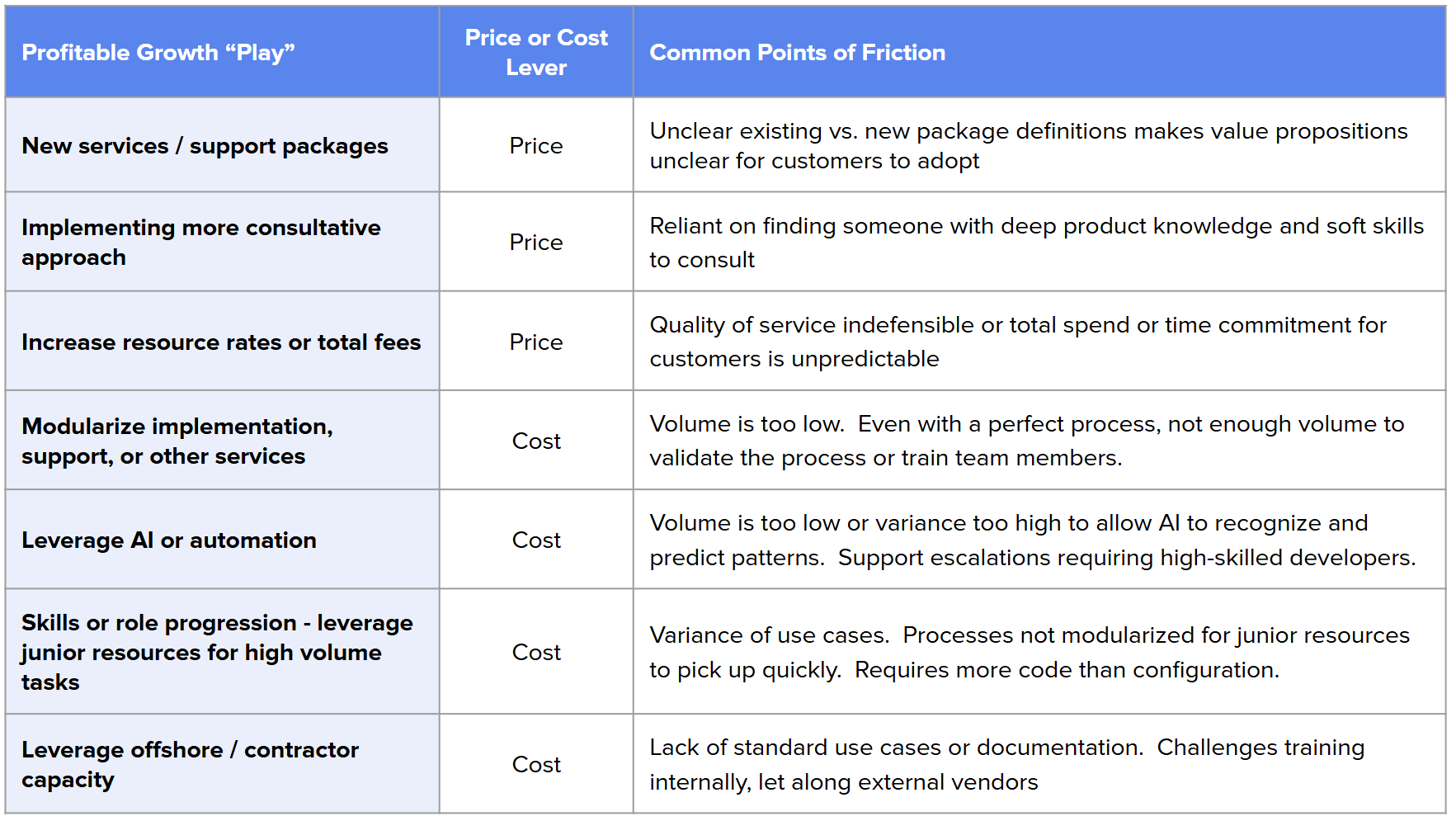
» If successful, services and overall company Gross Margin & EBITDA should increase over time.
Wrap-up
As the SaaS landscape continues to evolve, the value of integrating profitable services into your business model is becoming more apparent. While traditionally viewed as a cost center or loss leader, services are now positioned to drive profitability, enhance customer retention, and create significant differentiation in an increasingly competitive market. By focusing on value, operational repeatability, revenue predictability, and profitable growth, companies can unlock the full potential of their services offerings. The key is to remain agile, experiment, and continually refine processes to ensure services become a powerful tool in your overall strategy. With the right approach, services can be more than just a supplement to your software—they can be a cornerstone of your company’s long-term success.